Melanotan 1 vs Melanotan 2: Key Differences
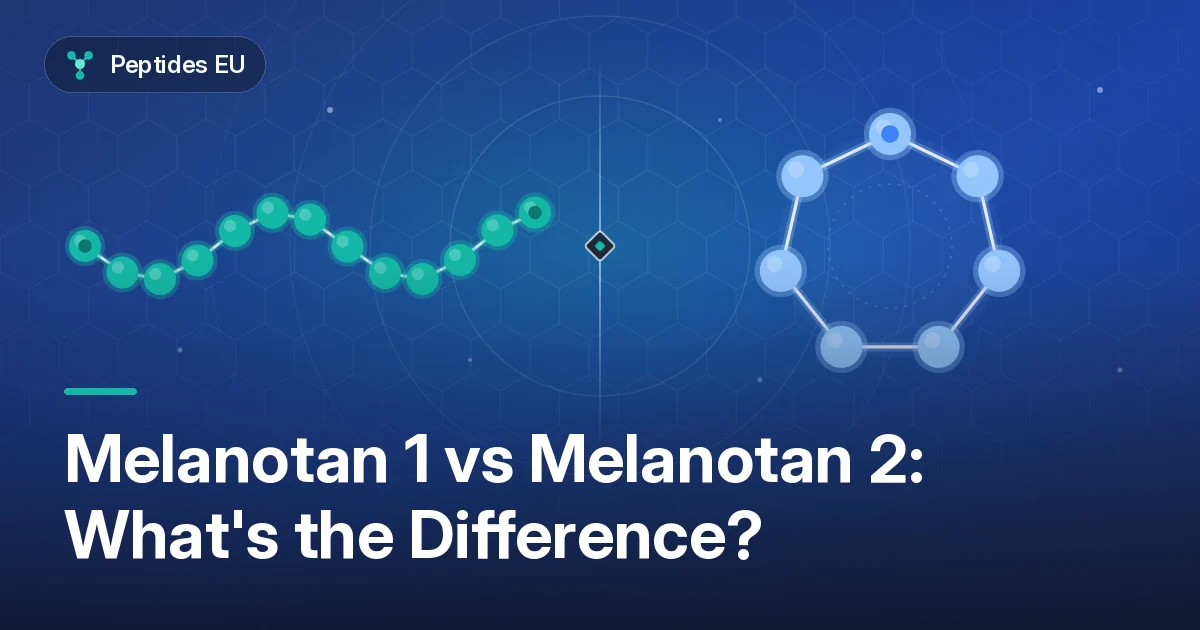
Melanotan 1 vs Melanotan 2 explained simply: where they come from, how their structure and receptor binding differ, and how to store them.
Melanotan 1 and Melanotan 2 sound like two versions of the same thing, and in a way they are. They come from the same research project and are built from a similar starting point. But up close they're quite different molecules. This guide explains, in plain language, what each one is, where they came from and how they differ.
Where the Melanotans come from
Both peptides go back to research at the University of Arizona in the 1980s. Scientists there were studying a natural hormone called alpha-melanocyte-stimulating hormone, or α-MSH for short. The body makes α-MSH, and it's involved in how cells produce melanin, the pigment that gives colour to skin and hair.
Natural α-MSH breaks down very quickly, which makes it hard to study. So the researchers set out to make lab versions, called analogues, that are more stable. Melanotan 1 and Melanotan 2 are two of the results.
What is Melanotan 1?
Melanotan 1 (often written MT-1 or MT-I) is a linear peptide of 13 amino acids. "Linear" means the amino acids sit in a straight chain, like beads on a string.
It's very close to natural α-MSH. The researchers swapped just two of the building blocks, which made the molecule far more stable while keeping its overall shape. Its scientific name is afamelanotide, and you may see it under that name in research papers.
What is Melanotan 2?
Melanotan 2 (MT-2 or MT-II) is a cyclic peptide of just 7 amino acids. "Cyclic" means part of the chain is joined back onto itself to form a ring.
This makes Melanotan 2 smaller and more compact than Melanotan 1. The ring structure also makes it very stable. Because it's a shortened, reshaped version of α-MSH, it behaves differently from its bigger sibling in lab studies.
The key differences at a glance
Comparison
Melanotan 1 — Linear (straight chain); Melanotan 2 — Cyclic (ring) Melanotan 1 — 13 amino acids; Melanotan 2 — 7 amino acids Melanotan 1 — About 1,647 g/mol; Melanotan 2 — About 1,024 g/mol Melanotan 1 — Afamelanotide; Melanotan 2 — Melanotan II Melanotan 1 — More selective; Melanotan 2 — Broader
Structure: chain vs. ring
The biggest difference is shape. Melanotan 1 keeps the long, straight form of the natural hormone, with two small changes. Melanotan 2 is cut down to the core section that matters most and then folded into a ring.
That ring isn't just a detail. In peptide chemistry, shape has a big effect on how a molecule behaves and which targets it fits. That's why two peptides from the same family can act quite differently in research.
Receptors: selective vs. broad
Both peptides work through a group of receptors called melanocortin receptors. You can think of receptors as locks on the surface of cells, with peptides acting as keys. There are five main melanocortin receptors, numbered MC1R to MC5R.
- Melanotan 1 is considered more selective. It mainly fits the receptor linked to pigment cells.
- Melanotan 2 is considered broader. It fits several melanocortin receptors, not just one.
This is one of the main reasons researchers treat them as separate tools rather than interchangeable versions of the same thing.
Regulatory status
Here the two peptides go clearly separate ways. A version of Melanotan 1 (afamelanotide) has been through formal clinical development and regulatory review in some regions, for a specific use under medical supervision.
Melanotan 2 has never been approved for human use anywhere. Health regulators in several countries have warned the public about unlicensed Melanotan products sold online. For anyone working with these peptides, the safest view is simple: they are research chemicals for laboratory use only.
A related peptide: PT-141
If you've read about Melanotan 2, you may also have seen PT-141 mentioned. PT-141 was developed from Melanotan 2 and is very similar in structure. It's another example of how small changes to a peptide can lead to a molecule that researchers study for quite different reasons.
Handling and storage
Both Melanotans are usually supplied as a white, lyophilised (freeze-dried) powder in sealed vials. A few basics apply to both:
- Keep unopened vials cool, in the fridge or freezer for longer storage.
- Keep them dry and out of direct light.
- Once reconstituted, keep them refrigerated and follow your lab's own handling guidelines.
When sourcing either peptide, look for a supplier that provides an independent Certificate of Analysis (COA), clear labelling with batch numbers and honest product information without bold promises.
The bottom line
Melanotan 1 and Melanotan 2 come from the same family but are clearly different molecules. Melanotan 1 is a longer, linear peptide that stays close to the natural hormone and is more selective. Melanotan 2 is a shorter, ring-shaped peptide that's more compact and binds more broadly. Their regulatory stories are different too.
If you're comparing the two for research, you can find Melanotan 1 and Melanotan 2 at Peptides EU, both supplied as freeze-dried vials for laboratory use.
This article is for general information only. Research peptides are intended for laboratory research use only and are not for human consumption. Nothing here is medical advice.
Related resources
All content is for in vitro laboratory research context only. Not medical advice.